Bookmark and ShareShare
Monday, May 21, 2012

CEOs: Bet Your Stock on a Great Workplace

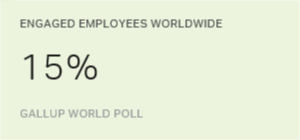
Wharton researchers have discovered there’s a significant difference in stock performance between great workplaces and lousy workplaces. You’d think this would be common sense, but it’s not -- most U.S. workplaces are either miserable or apathetic. Specifically, 19% of employees are miserable, or as Gallup calls them, “actively disengaged”; 52% apathetic, or “not engaged”; and 29% inspired, or “engaged.” That means tens of millions of American employees are not engaged in their jobs.

Bottom line, great workplace stock outpaces average workplace stock by an average of about 3% per year, according to Wharton. So if you invested in a portfolio of great workplaces versus average ones over 25 years, you’d double your money. Which would you prefer for your retirement or your kid’s college savings?

Honest to God, this chief executive gave up long ago on fellow CEOs who run vast workplaces of misery and apathy. I know and socialize with many U.S. and international CEOs, and I can tell you that at the end of the day, many aren’t deeply concerned by the disengagement of their workforce. Okay; so be it. They will attempt to win through acquisitions and price cutting.

But these leaders will struggle to build anything with a soul and character and rich purpose -- something with infinite possibilities for innovation and entrepreneurship, with real and dynamic explosions of customers. Nor will they build something as profitable as it could be.

My big question: Why don’t boards of directors push for higher returns on investment in their employees and demand workplace audits? There’s actually a worldwide gold standard currently used by the best managed companies in the world. It’s called the Gallup Q12: The 12 best questions ever invented to ask employees what they think of their workplaces and managers.

Think of the Q12 just like a financial audit by PricewaterhouseCoopers. If every board in the world started requiring a Gallup audit of employee inspiration presented right next to the quarterly operating statement with benchmarks, it would dramatically improve stock performance. It would also change the world.

6 comments:

Bharat said...
May 21, 2012 at 12:10 PM  

For companies which have less bench strength , we normally might observe a high scope for engaged employees as they are assigned with more reponsibility thus making then more visible among the company due to their significant contributions.

However companies that have high bench strength may host disengaged employees as most of them are lost in the crowd lacking carrier development direction and motivation.

The Q12 will be an effective medicine to treat the bigger companies as they can audit the huge employee base.The most important thing here is the intention to improve as the management should digest every spectrum of Q12 results to make game changing decisions.

Arabian Alien said...
May 30, 2012 at 7:04 AM  

Nice perspective on how to invest. I wonder if there are any investment vehicles modelled on this theory?

Anonymous said...
June 14, 2012 at 9:34 PM  

Completely agree with this one. I work for a large multinational and feel less than appreciated at the end of a long day!

Anonymous said...
June 16, 2012 at 8:03 AM  

"The most important thing here is the intention to improve as the management should digest every spectrum of Q12 results to make game changing decisions."

This is the key to achieving the goal of a great workplace. My experience is the lower level management is the place where the decisions affect the day-to-day mental state of the employees.

Talk will get nothing done, action is the key to success. When is the last time your lower level management has been put through some motivational and sensitivity training??

Anonymous said...
July 15, 2012 at 10:38 PM  

Iam a manager and try to use the principals of the Q12 in my store. I have taken a new position and am at the moment still in trainee status. I have been severly mistreated in my training and now in a different store enviroment Iam being berated 30 to 40 min at a time at least once a week. I have never seen so many disengaged "managers" in my entire career. I have been in management for many years but have never witnessed such a employee unfriendly atmosphere. I very much want to go on to manage a store for this company but wonder if it is possible considering the feed back coming from the managers that are supposed to be my trainers. This is very perplexing to an employee hired as a manager and then never allowed to perform that duty.

Anonymous said...
August 19, 2012 at 10:50 AM  

I used Jim's approach in the early 90s by investing in companies that were early leaders in Peter Senge's practices described in his book The Fifth Discipline. Those companies bought included Analog Devices, Hanover Insurance, Royal Dutch Shell, Intel, and HP. I would review the annual conference attendance roster to see which companies were sending their leaders. Interesting that GE and Microsoft rarely (never?) attended.
Since I discovered Gallups work on strengths, I have looked for companies in a similar fashion. One I have done very well with is Standard Chartered Bank, highlighted in Gallups Strengths Based Leadership. Best Buy, compared to Circuit City is another example, although am not sure what has been going on there lately.
I would certainly be interested in joining a Facebook group who would share research on companies leading the way in strengths, as I totally agree with Jim's approach. Sounds like the company mentioned in the preceding post would be a short candidate.

Post a Comment

Comments are moderated by Gallup and may not appear on this blog until they have been reviewed and deemed appropriate for posting.

Copyright © 2010 Gallup, Inc. All rights reserved. | Terms of Use | Privacy Statement