The news coverage you’re seeing of the attacks on U.S. and other embassies in the Middle East is, frankly, uninformed. Reporters and talking heads, not to mention diplomats, are severely misinterpreting the reality and deep-seated attitudes on the ground.
Let me give you my view on this as bluntly as possible: This is not about religion. Rage in the Middle East has never been about religion, or not primarily so.
The anger you’re seeing stems from the desperation and personal humiliation of young males who have no jobs.
Yes, of course, this idiotic anti-Islam video has triggered chaos, just as Quran burnings have done in the past. But anger over disrespect toward Islam is, in my view, a proxy for the deep and searing pain that young males feel when they are desperately and hopelessly unemployed.
To illustrate: Gallup finds that 18% of adults 15 years and older living in the Middle East and North Africa region have a full-time job with an employer -- well below the global average and most other regions. This Payroll to Population employment rate, as Gallup calls it, is 22% in Egypt, at 24% in Tunisia, and at 10% in Yemen. The extraordinary discomfort of joblessness, which is felt most painfully by young males, is what’s really driving instability in these countries and others nearby.
Consider their state of mind. A young Muslim male in, say, Egypt who has no job cannot get married. And if he can’t get married, he can’t have a family and all of the things that make life complete. Not having a job nor a wife, he experiences deep personal disgrace and humiliation that needs an outlet. What’s worse, he believes he will never get a job. That is where you find the deadly state of hopelessness. And, of course, compounding all of this is perceived corruption throughout society, particularly in government.
Now, despite the images you see on TV and the misguided reporting on the subject, the deep-seated anger isn’t really toward America or Germany or England, in my view. Western nations are merely the scapegoats of extreme human pain and humiliation.
The fact is, the U.S. and other Western nations cannot diplomatically finesse or bomb their way out of the growing anger in the Middle East. Rather, they must deeply understand the will of the young males there --- and theirs is no different than the will of everyone in the world, in every country, everywhere. One of Gallup’s most significant findings is that what everyone in the world wants most is a good job. In this sense, a young male in Alexandria, Egypt, is no different than his counterpart in Alexandria, Virginia.
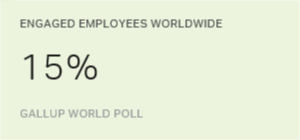
How can the Middle East, with the West’s help, produce more good jobs? By expanding free enterprise throughout the region. Until the Middle East is 100% committed to creating customers, there will never be authentic, sustainable job growth. Jobs follow customers, and customers are created by highly engaged workplaces. Every time an engaged workplace creates a new customer, it creates new jobs. The more this happens, the better off a society becomes. Rage is replaced by the rewards of prosperity.
Let me give the last word here to Abdullah, a young car salesman in the Middle East. He shared the thoughts below while taking one of Gallup’s leadership courses. You should send this quote to every lousy leader, misguided diplomat, and wrong-headed reporter in the world, because he clearly sees the solution that everyone else is missing:
“Engagement is bigger than me. It means if I do my job well, then I can care for my family. If my team does their job well, they can care for theirs. If together we care for our customers, then we create more opportunities for growth. That means more jobs for the people in our community, sustainability for our economy, increased freedoms and choices for our region. It’s not enough to see this as a way to please our customers. The truth is, it’s the way to save the world.”
Monday, September 17, 2012
Share
11 comments:
What you say may be true, however what you say won't happen unless one important thing precedes. Education.
Jim Clifton is right on the money with his commentary. The key to political stability in any nation is a strong middle class that has both discretionary time and financial resources to be politically involved.
Jim Landers, columnist with The Dallas Morning News identified this problem a decade ago in a June 24, 2002 column titled "
EMPLOYMENT CRISIS HAS SAUDI ARABIA SIMMERING" JEDDAH, Saudi Arabia - Hundreds of thousands of young Saudis are graduating from schools and universities in an economy that creates only 25,000 jobs a year.
That suggests a huge unemployment problem. The real issues, however, are whether Saudi employers can be pried loose from a business model built on cheap foreign labor - and whether young Saudi men and women are willing to settle for much less than their parents.
This may be a matter of indifference to Americans, until you think about who hijacked those airplanes Sept. 11. Fifteen of the 19 were young Saudis from middle-class backgrounds.....
True, it's easy to sit on a sun kissed porch sipping coolade while the rest of the world doesn't have jobs. The leading economy has a responsibility to the rest of the world to show the path towards prosperity and peace.
Spain has an unemployment rate of 50% among younger then 25 population. I don't see them killing our embassador or each other. There must be something missing in Mr. Clifton's rational.
I agree with Jim. Greece has 55% unemployment, the near term future does not look bright, rising consumer inflation, crushing austerity. Along with this comes protests, anger, rising militancy and attacks on immigrants. The situation in the middle east didn't just happen in the last few years but has been growing for the past several decades. That is the main difference between Egypt and Spain.
LOL - boiling the situation down to idle hands and a forced consumer society, maybe at that point we can hollow their lives out to the point of our own.
Actually Spain and Greece have had their share of civil unrest and violence during demonstrations. Unemployment and economic problems like those outlined in this piece are to blame. Also, the assassination of Ambassador Stevens was likely a targeted rather than random act of violence.
while there is something to be said for this analysis, it is only sometimes true. Iran is an example where it was not true. during the days of the Shah, there was a strong middle class. The Shah's numerous development projects transformed Iran into an industrial, urbanized country. Public education progressed rapidly, and new social classes - a professional middle class and an industrial working class - emerged. then the Islamists, with their backward ideas, came to power (with the help of Jimmy Carter). And we all know how that is turning out. so it is clear from the recent history in Iran, that extremism can take hold even in a country with a strong, relatively educated middle class. For that matter, one can even look at Germany during WW2. Extremism (a different kind, but extremism nonetheless) also took hold of an educated population with a strong middle class.
I agree Jim Clifton's idea that lack of jobs is part of the problem. A poster adds that lack of education is another part, but I differ there. Many countries have accessible education but no job opportunities after college. Radicalization steps into the void…
I very much agree with the idea that we need to stop bombing people when a problem arises. It satisfies no needs except that of the defense industry to blow up ordnance so more can be manufactured.
Unfortunately, this rationalization of what is happening in the Middle-East is totally incorrect. Anger is spreading throughout all segments of the Arabic and Muslim societies from the unemployed to the employed, from the poor to the rich, from the common people to the most elite politicians. It is an unconscious reaction of peoples who can tolerate anything except for disrespect of their religious symbols. Unlike Western secular societies, most Muslims are deeply attached to their religious beliefs and this is even encompassed within the political systems which no matter how secular they try to appear , are obliged to compromise with these religious traditions. For instance, a Pakistani government minister offers a $ 100,000 for killing of the maker of the anti-Prophet film ( http://worldnews.nbcnews.com/_news/2012/09/22/14036172-pakistan-official-offers-100000-reward-for-killing-of-maker-of-anti-prophet-muhammad-film?lite ). In fact, Mr. Clifton’s analysis of the issue seems so logical. Yet, this analysis would have been more appropriate had it been directed to the contemporary unrest that is taking place in the countries which have been witnessing the “Arab Spring” – a case whose impulses are completely different from those behind the widespread reactions against the disrespectful film.
I'm trying a second time to comment, my first apparently didn't pass your reviewers. If you look at Gallup's own World View data you will find the conclusions reached in this blog unsubstantiated. Throughout most of the Middle East self-perceptions of corruption, labor market and life in general are often better than that in the United States. Saudi Arabia outstrips the US on nearly every one of these measures according to Gallup's research that claims that it can get comparable answers to these questions from nearly every country. I can only wonder if I have misinterpreted the World View data or if Mr. Clifton's ideology has blinded him to the data his own company reports. As good as the customer-engagement studies are it's a long and complicated road from there to peace in the Middle East.
Jim Dezieck
Post a Comment